A data center can appear complete well before it is operationally ready. Construction may be substantially finished, equipment may be staged, commissioning milestones may be approaching, and the white space may look presentable during a walkthrough. Yet the physical environment can still carry meaningful operational risk.
That risk is especially relevant today because the data center market is operating under extraordinary pressure. Global demand for digital infrastructure is expanding rapidly, driven by cloud adoption, AI workloads, colocation growth, and enterprise modernization. Industry research points to a global infrastructure buildout measured not in isolated projects, but in tens of gigawatts of new capacity through the end of the decade. In that context, construction velocity is no longer a background issue. It is a strategic operating variable.
The final cleaning phase is often treated as a closeout activity. In mission-critical facilities, that framing is too narrow. Post-construction cleaning should be viewed as an operational readiness control.
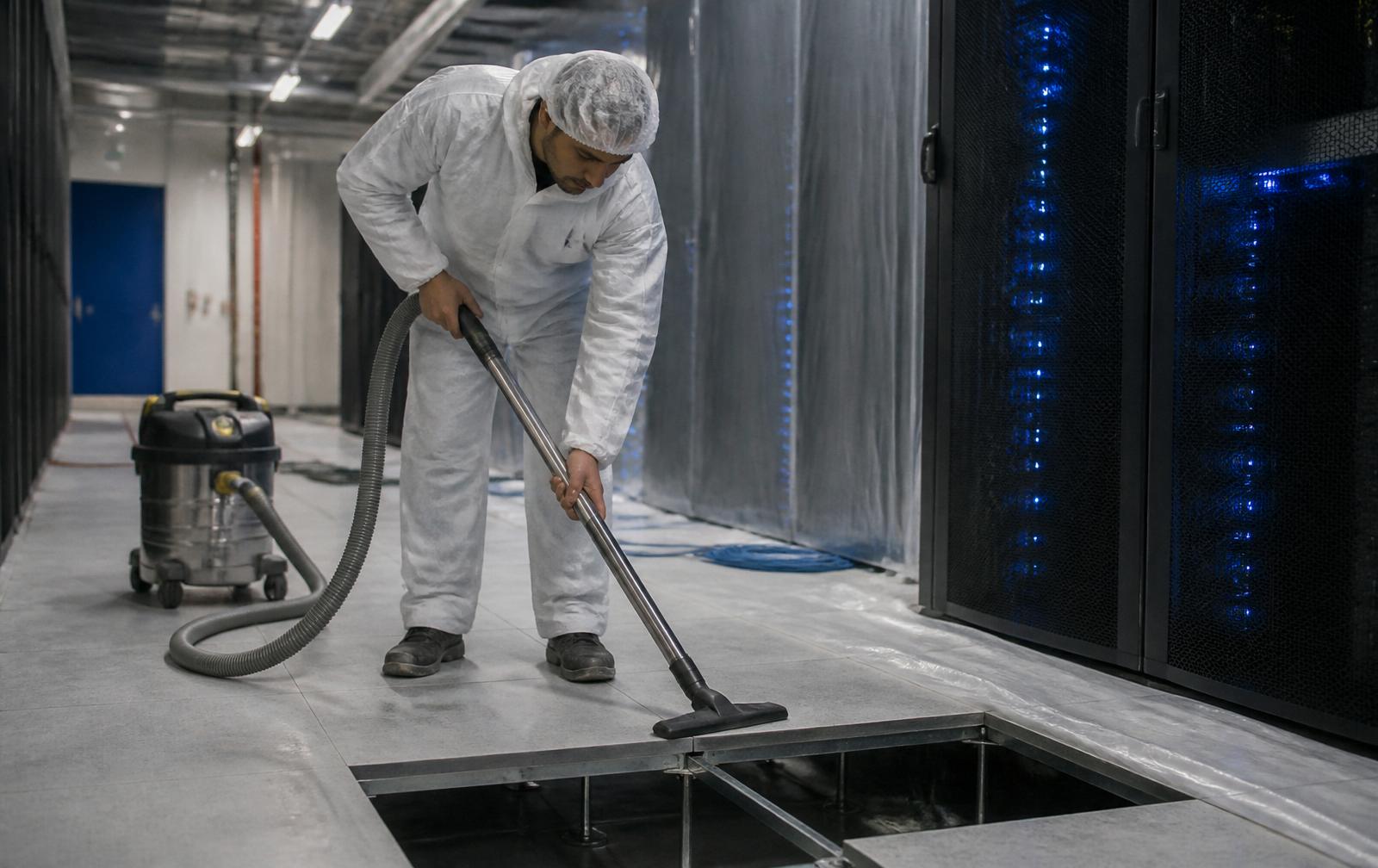
The reason is straightforward: construction leaves residue. Fit-out work, equipment installation, slab work, cabling, packaging, trade activity, and punch-list execution can leave behind fine particulate, concrete dust, metal fragments, adhesive residue, packaging debris, cable remnants, and contamination in spaces that become harder to access once racks, cabinets, containment systems, and critical equipment are fully installed. In a conventional building, those conditions may create a housekeeping issue. In a data center, they can affect airflow discipline, cooling pathways, equipment-adjacent areas, customer confidence, and turnover quality.
The most important contamination is often not the most visible. A basic visual inspection may confirm that the space looks clean while fine particulate remains in raised floor voids, cable pathways, overhead areas, equipment-adjacent surfaces, loading routes, or intake-adjacent zones. ISO 14644-1 is relevant because it establishes a recognized framework for classifying air cleanliness by airborne particle concentration. IBM's contamination guidance also states that data centers must meet ISO 14644-1 Class 8 cleanliness for particulate contamination and notes that airborne particulates and reactive gases can pose hardware risk when combined with environmental factors such as humidity or temperature.
This matters because reliability economics are unforgiving. Uptime Institute's outage research has shown that more than half of significant, serious, or severe outages reported by respondents cost more than $100,000, with a meaningful share exceeding $1 million. While post-construction particulate is only one risk factor within a much broader operating environment, the implication is clear: preventable failure modes deserve structured controls. Facility teams do not need perfection. They need disciplined handoff.
A professional post-construction cleaning program should therefore answer a different set of questions than a standard cleaning closeout. What zones were cleaned? Which areas were inaccessible? Was the raised floor plenum addressed? Were airflow pathways considered? Were packaging and construction residues removed from operationally sensitive areas? Were exceptions documented? Were turnover records provided in a format useful to the general contractor, commissioning team, facility manager, and owner?
This is where documentation becomes a differentiator. In high-growth infrastructure markets, speed can create ambiguity. Multiple trades, compressed schedules, phased turnover, early equipment delivery, and overlapping commissioning activity can make it difficult to maintain a single view of physical readiness. A cleaning provider that only delivers labor leaves the facility team with limited evidence. A partner that documents scope, observations, exceptions, and completion provides a more useful operating record.
For general contractors, documentation supports handoff quality. For commissioning teams, it supports readiness confidence. For facility operators, it reduces ambiguity before the environment enters live operations. For owners, it creates a record that the final phase was managed with appropriate discipline.
Capitol Core's approach is designed around that requirement. The company combines contamination-controlled execution with structured documentation, service verification, and KPI-enabled reporting. That enables partners to understand what work was completed, when it was performed, which areas were addressed, and what observations should be considered before commissioning or operational handoff.
The strategic point is simple: the final clean is not simply the last task in construction. In a data center, it is one of the first controls in operational risk management.